

Why provenance beats detection
AI detectors output a probability, not a fact — and the false positives land on real people. Here is why recording where content came from beats guessing after the fact.
On this page›
A teacher pastes an essay into an AI detector and gets back a number: 87% likely AI. A hiring manager runs a cover letter and sees 40%. A platform screens an uploaded photo and the tool shrugs at 55%. Everyone stares at a percentage and has to decide what to do with a machine's hunch. That is the whole problem with detection: it hands you a guess and calls it evidence.
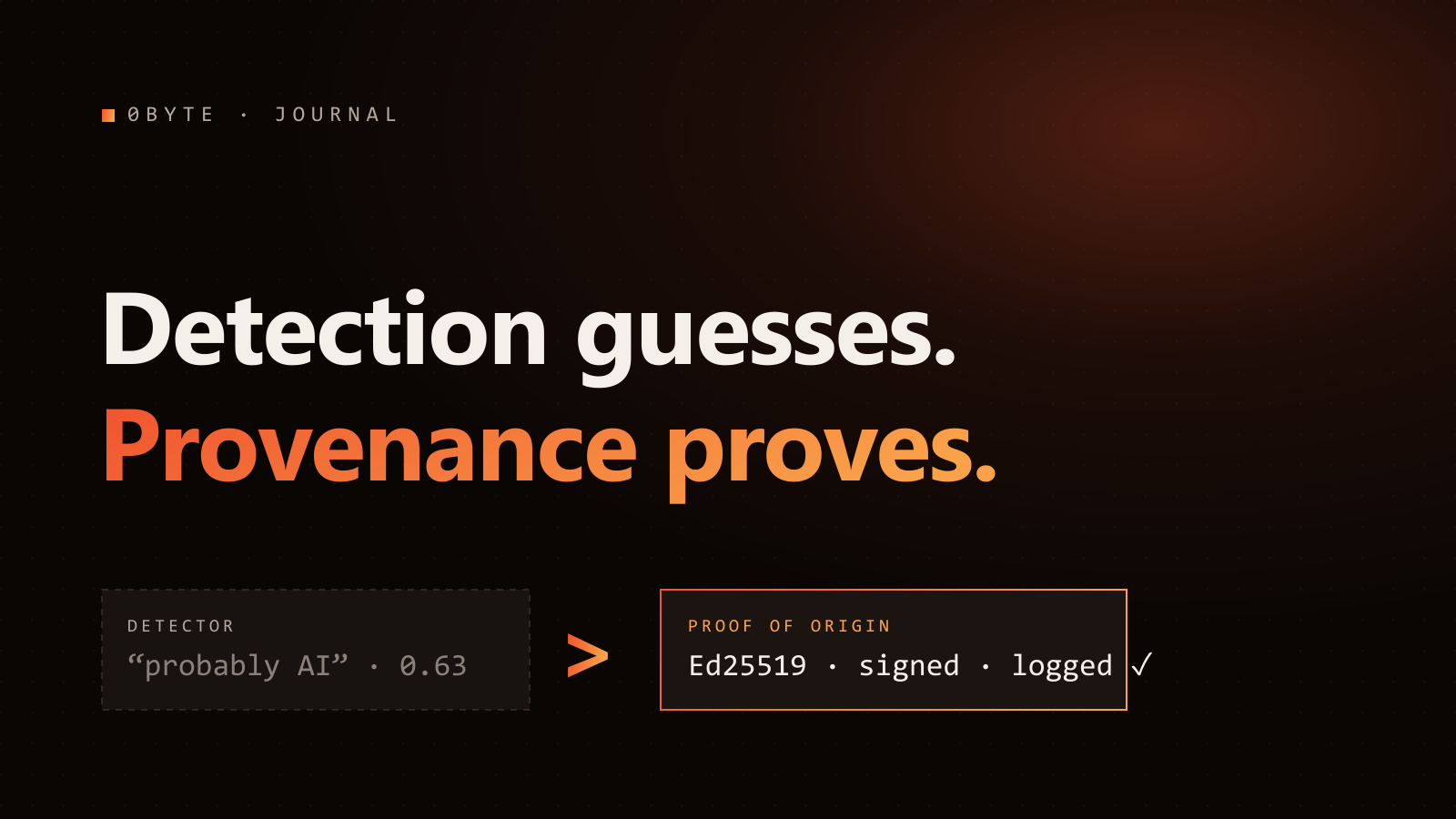
There is a better question than "is this AI?" — and it is "where did this come from?" One is a forensic guess made after the fact. The other is a record made at the moment of creation. This post is about why the second approach wins, and why the industry is quietly shifting toward it.
Detection is a probability, not a fact
An AI detector is a classifier. It looks at content, compares it against patterns it learned from training data, and returns a likelihood. It never knows anything — it estimates. And the estimate degrades the instant the world moves on: a new model, a light paraphrase, a re-crop, a screenshot, and the patterns the detector relied on are gone.
The most telling admission came from the company with the most to gain from detection working. In July 2023, OpenAI quietly retired its own AI-text classifier, citing a "low rate of accuracy." Its published numbers were brutal: it correctly flagged AI-written text only 26% of the time, while wrongly flagging human writing as AI 9% of the time. If the lab that trains the models can't reliably detect their output, a third-party tool bolted on afterward is not going to do better.
Detection is also an arms race with a built-in loser. Every improvement to a detector is a training signal for the next generation of models to evade it. You are always one release behind, forever.
The false positives land on real people
A detector's error rate isn't an abstraction on a dashboard — it falls on individuals, and not evenly.
A Stanford team tested seven widely used GPT detectors on essays written by non-native English speakers. The detectors flagged 61% of the human-written TOEFL essays as AI-generated, while misclassifying essays by native speakers only about 5% of the time. The reason is mechanical: detectors lean on "perplexity" — how predictable the wording is — and non-native writing tends to use a smaller, more predictable vocabulary. The tool wasn't catching cheating. It was penalizing people for how they write English.
Now multiply that by every classroom, admissions office, and content platform that treats a detector score as a verdict. A system that is wrong in one direction wastes time; a system that is wrong in this direction quietly discriminates. "Probably AI" is not a fact you can act on fairly.
Watermarks are a fence with a known gate
Watermarking is the more serious cousin of detection: instead of guessing later, the generator hides a signal inside the output at creation time. Google's SynthID does this for images, audio, text, and video. It is real engineering, and it helps — but it carries two structural limits.
First, coverage. A watermark only exists if the model that made the content chose to embed it. It protects one vendor's ecosystem. The open-weight model someone runs on their own GPU adds nothing, and that is exactly the content you most want to trace.
Second, durability. Watermarks live inside the pixels, and pixels get rewritten constantly — recompression, resizing, screenshots, filters. Researchers have shown that invisible image watermarks are, in a formal sense, provably removable: add noise and regenerate the image with a diffusion model, and the mark is gone while the picture looks the same. Anything embedded in the bytes shares the fate of the bytes.
Provenance flips the model
Provenance doesn't interrogate content after it spreads. It records the origin at the moment of creation and makes that record independently checkable. In 0byte's design that means three things working together:
- A perceptual fingerprint — a compact hash of what the content looks or sounds like, not of its exact bytes.
- A signed proof of origin — who created it, with which model, and when, cryptographically signed so it can't be forged.
- A public transparency log — an append-only ledger, so the record can't be quietly rewritten after the fact.
Nothing is hidden inside the file. The image you ship is byte-for-byte identical to the one you'd ship without 0byte. The proof lives beside the content, in a place the open internet can't strip.
Why a fingerprint survives what a watermark can't
The move that makes this durable is fingerprinting on perceptual features instead of raw bytes. Two files that look identical to a human — the original and a re-encoded, cropped screenshot — produce nearly the same fingerprint, even though not a single byte matches.
So the failure modes that kill watermarks and detectors become non-events:
- Screenshot it — the fingerprint still matches.
- Recompress or resize it — still matches.
- Strip the metadata — there was never anything in the file to strip.
There is no embedded mark to remove, because the "mark" is the content's own appearance, registered once and checkable forever. And because the proof is anchored in a public log — the same idea that underpins Certificate Transparency for the web's TLS certificates — no one, including us, can rewrite history.
What a regulator will actually accept
This stops being philosophical on August 2, 2026, when the EU AI Act's transparency obligations (Article 50) take effect. Providers putting AI-generated content into the EU market must make it detectable as machine-generated.
Imagine demonstrating compliance with a detector: "our tool thinks it's 84% AI." That is not a record — it's an opinion that changes with the next model. Now imagine demonstrating it with provenance: a signed proof, in a public log, that says this content was generated by this model at this time, verifiable by anyone, for free, with no account. One is a shrug. The other is an audit trail.
Detection asks; provenance answers
Detection will always have a role at the margins — triage, spam filtering, first-pass screening. But you cannot build trust, policy, or law on a number that is one model release from being wrong, and that misfires hardest on the people least able to argue back.
Provenance is the opposite bet: don't guess where something came from — record it when it's made, and make the record outlive the file. Detection asks a question nobody can answer with confidence. Provenance already wrote the answer down.
Further reading: OpenAI scuttles its AI-written-text detector over "low accuracy" · GPT detectors are biased against non-native English writers (Stanford, Patterns 2023) · Invisible image watermarks are provably removable using generative AI · Google DeepMind SynthID · C2PA content provenance standard · EU AI Act, Article 50 · Certificate Transparency (RFC 6962)
Want proof of origin on your own AI content?